
Understanding Awning Wind Ratings: A Columbus Homeowner’s Guide to Safety and Longevity

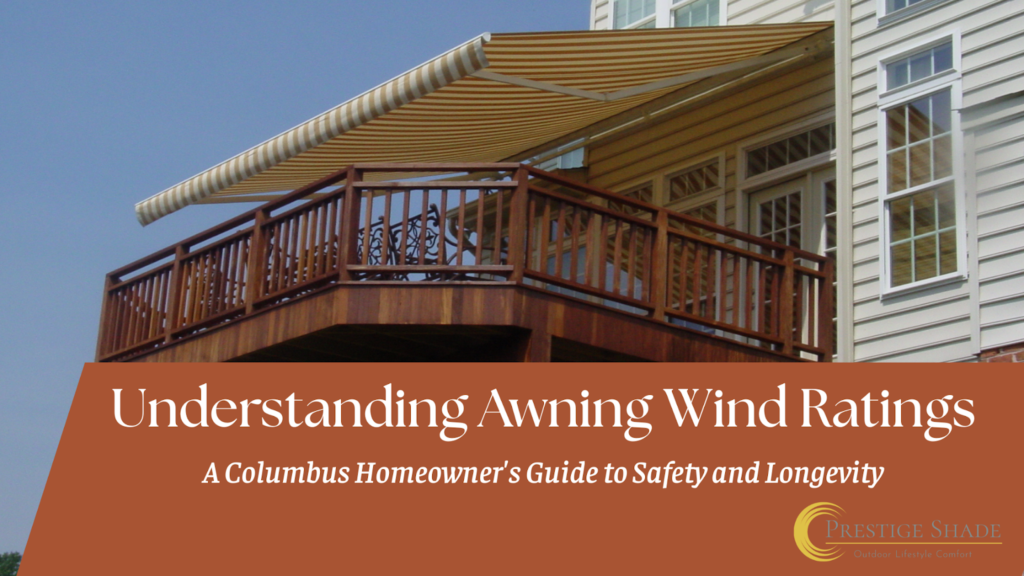
Ohio weather rarely gives much warning. You spend a calm afternoon enjoying a cold drink on your Columbus patio, and suddenly you notice a gust of wind and a wall of clouds rolling in from the west. That unpredictability makes understanding your awning’s wind rating one of the most practical things you can do as a homeowner. Wind ratings directly affect how safe your awning is during a storm, how long it will last, and how much maintenance it will need over time.
This guide covers what wind ratings mean, how they are determined, and how to use that information to protect your investment from season to season.
What Does “Wind-Rated” Mean?
A wind-rated awning is a shade system that has been tested and certified to remain safely deployed in winds up to a specified speed. For most residential retractable awnings, wind ratings typically range from 20 mph on the lower end to 40 mph or higher for premium models.
Think of a wind rating as a verified promise — an honest, engineering-backed baseline, not a marketing claim. It tells you exactly what the system has proven it can handle.
Non-rated awnings don’t offer the same promise or security. They may look the part at a lower price point, but without certification, their structural performance in real wind conditions is simply unknown. And when you live in Central Ohio, an area where the weather can change at a moment’s notice, that uncertainty may come at a cost higher than what you originally saved.
How Wind Ratings Are Determined
Wind ratings come from wind tunnel testing, materials analysis, and structural modeling. Engineers push the awning to increasing wind speeds, documenting exactly where each component — the frame, fabric, fasteners, and mounting hardware — begins to show stress or failure. The final rating reflects the weakest point in the system, which is why installation quality is inseparable from product quality.
Sunesta is the first and only retractable awning manufacturer to earn Miami-Dade County Approval, a certification requiring verified performance in winds up to 90 mph and one of the most rigorous benchmarks in the industry.
At Prestige Shade, every installation is built on Sunesta’s proprietary Smart Mount system, anchoring the awning securely to an exterior wall, overhang, or roof. That foundation is what allows a Sunesta awning to perform reliably through Central Ohio’s fast-moving seasons, where a 70-degree afternoon and a severe storm warning can share the same forecast.
Wind Rated vs. Non-Rated Awnings: What the Difference Looks Like When It Matters
From the curb, a wind-rated awning and a non-rated one will appear identical. However, wind-rated awnings typically feature reinforced arms, stronger fabric tension systems, and hardware engineered to handle lateral pressure. Non-rated models will often cut corners on these internal components, while maintaining the same appearance as the higher-end models.
The consequences of that difference become clear during a storm. A properly rated awning holds its position through the kind of gusts that would tear fabric, bend arms, or pull mounting hardware off a lesser system. For families using their awning daily, or for anyone leaving it extended while away from home, that structural reliability is the difference between an awning that weathers the season and one that needs replacing after a single storm.
Explore Prestige Shade’s full range of products and services to compare available Sunesta models, including size ranges, frame options, and fabric specifications.
Wind Sensors: The Smartest Layer of Protection You Can Add
Even a wind-rated awning depends on being retracted when conditions exceed its threshold. Wind sensors are the first line of defense against accidental damage. These devices monitor real-time wind speeds around the awning and automatically signal it to retract when gusts reach a preset level, before conditions ever reach the point where damage becomes a risk.
The difference between a properly calibrated wind sensor and relying on manual retraction is significant. Manual retraction requires the homeowner to be present, paying attention, and willing to act quickly. A sensor handles that response automatically, even during a sudden afternoon storm when you may be indoors or away from home entirely.
Prestige Shade carries wind sensors as part of its awning accessories lineup, alongside sun and rain sensors that add a further layer of automated protection. These accessories work best when calibrated to the specific wind rating of the installed awning, rather than set to generic thresholds that may not match the product’s actual performance limits.
Safe-Use Habits Every Awning Owner Should Know
Day-to-day safety depends on how the awning is used and cared for. Here are the practices that matter most for Columbus-area homeowners:
- Retract your awning whenever high winds are in the forecast, even if conditions look calm at the moment.
- Never leave it extended overnight or during extended periods away from home.
- Use a wind sensor as a backup layer of protection, but not as a replacement for your own judgment.
- Check the local forecast before extending during spring and summer, when Central Ohio storms develop faster than most people expect.
- Inspect mounting brackets, fabric, and moving parts at the start and end of each season.
- Address any loose mounting hardware, fraying or unusual mechanical sounds before they become something more expensive.
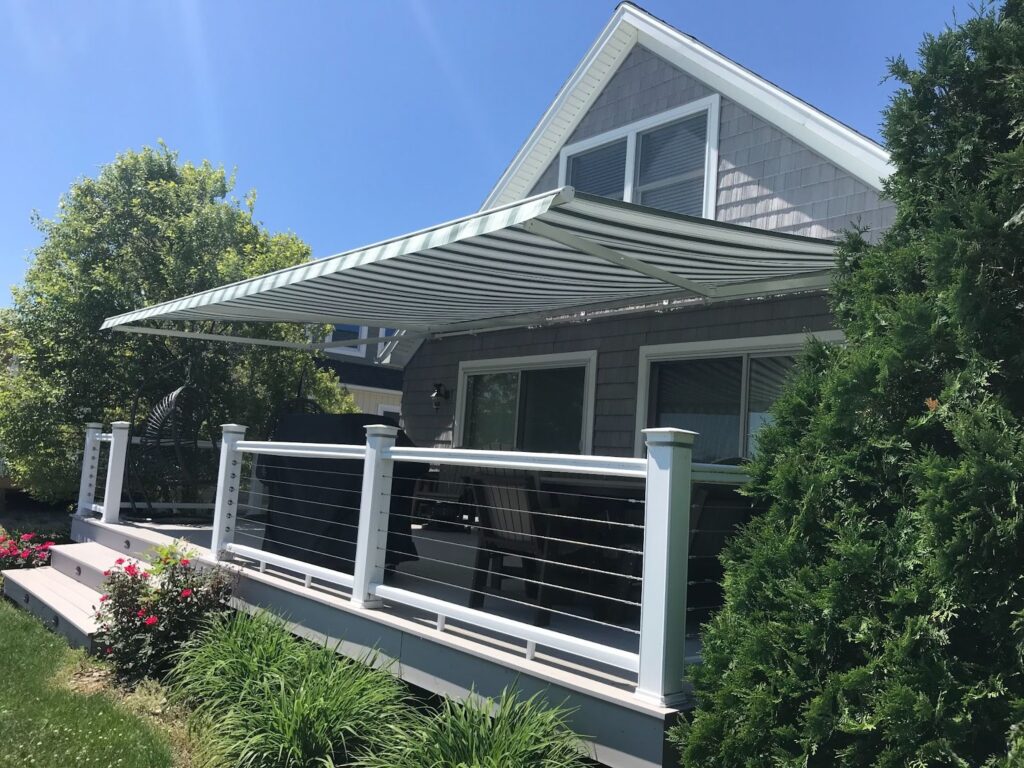
How Wind Rating Affects Maintenance and Longevity
Your awning’s wind rating shapes how much ongoing attention it needs and how long it will realistically perform. Lower-rated awnings demand more vigilance — quicker retraction decisions and closer attention to fabric tension and mounting security. Higher-rated systems offer more breathing room when the weather turns, but no awning is maintenance-free.
A biannual inspection is a dependable standard. Check the frame, arms, and mounting hardware for stress or corrosion at the start of each season. Clean the fabric with mild soap and a soft brush, letting it dry fully before retracting to prevent mildew. Motorized awnings benefit from a full operational test each spring, since motor alignment and limit settings can shift after months of winter dormancy.
Sunesta awning frames carry a limited lifetime warranty, with a 10-year fabric warranty and a 5-year motor warranty. Consistent maintenance is what keeps those warranties meaningful. Prestige Shade’s accessories page outlines the full range of sensors and protective add-ons that complement any Sunesta installation.
Finding the Right Awning for Your Columbus Home
Not every awning is the right fit for every home. The right awning depends on your patio’s orientation, typical wind exposure at your location, and how you realistically plan to use the space. A south-facing patio in an open yard carries different demands than a covered deck with natural wind protection on multiple sides.
Prestige Shade works with homeowners across Greater Columbus to evaluate those factors before making a recommendation. The Sunesta lineup spans a range of sizes and feature levels, with over 100 fabric options and up to five frame color choices. Every awning is custom-built to order.
Your outdoor space should feel like an extension of your home. Understanding your awning’s wind rating, pairing it with the right accessories, and building a few smart habits into your routine is what turns a shade product into a lasting investment in how you live.
Contact Prestige Shade today to schedule a free in-home estimate and find the solution that fits your space, your usage habits, and the Columbus climate.