
Why Columbus Patios Need Retractable Screens

August in Columbus is a study in contradictions. The evenings are warm enough to stay outside for hours. The gardens look their best. There’s still enough summer left to justify keeping the outdoor furniture out, the cooler stocked, and the back patio in rotation for every weekend gathering.
There’s also the part nobody talks about in the patio furniture catalogs: the west-facing glare that hits your guests in the eyes right around cocktail hour, the mosquitoes that arrive within twenty minutes of sunset, and the privacy question when the neighbor’s yard suddenly fills up at the same time yours does.
If you’ve been dealing with those problems, you’ve probably wondered whether there’s a better solution than citronella candles and asking everyone to face east.
There is.
Retractable screens are how Columbus homeowners are solving the specific outdoor comfort problems that a standard awning doesn’t address — and how they’re getting more hours out of their patios in the back half of summer.
Here’s what you need to know.
What Retractable Screens Actually Do
Start here, because there’s some confusion in the market.
A retractable awning handles overhead shade. It extends outward from the house on a horizontal plane and creates a covered zone above your seating or dining area. It’s the right tool for blocking direct overhead sun, reducing surface heat on your deck or patio, and cutting UV exposure.
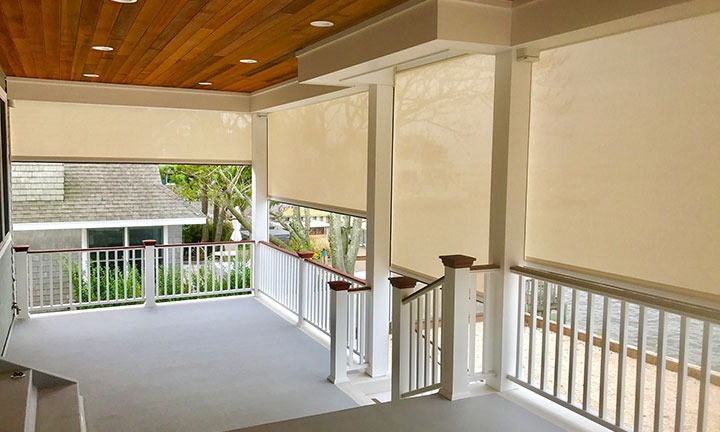
Retractable screens solve a different set of problems. They drop vertically from a housing mounted at the top of your patio opening, creating a wall of screening across one or more sides of the space. What that means in practice:
- Insects — screens are a genuine barrier. Mosquitoes, gnats, and flies that make August evenings miserable cannot get through. This is the single most common reason Columbus homeowners seek protection in addition to patio shade.
- Low-angle glare — afternoon sun in Columbus comes in at a steep angle in August, and overhead fabric doesn’t catch it. A screen deployed on the west side of your patio handles it.
- Privacy — when you’re entertaining outdoors, a deployed screen creates a soft visual barrier from neighboring yards and streets without walling you in.
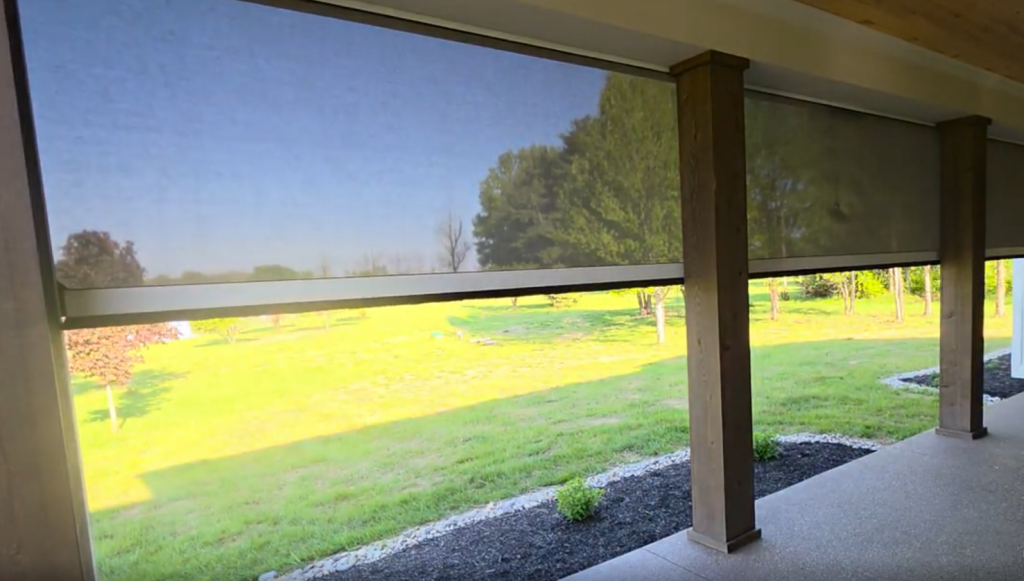
The key detail: screens retract when you don’t need them. That’s what separates a retractable screen system from a permanently screened porch. When you want the open air, the screen disappears into its housing. Your patio looks exactly as it always did.
Some homeowners use an awning and screens together to create what amounts to a fully functional outdoor room — covered overhead, screened on the sides — without any permanent construction. That combination is worth understanding before you decide one way or the other.
The Sunroll and The Sentry: Which Is Right for Your Patio Shade?
Prestige Shade carries two Sunesta retractable screen systems. They’re designed for different installation situations and different functional needs.
The Sunroll is a motorized retractable screen system with a cassette housing that keeps the screen fabric contained and protected when retracted. Widths up to 20 feet; drops up to 12 feet. The housing mounts at the top of the opening, and the screen deploys and retracts at the push of a button. It’s a clean system — the housing profile is minimal, it integrates with the home’s exterior without looking industrial, and the full range of Sunesta screen fabrics is available, from solar screening that filters light while maintaining a view to solid privacy panels that close the space entirely.
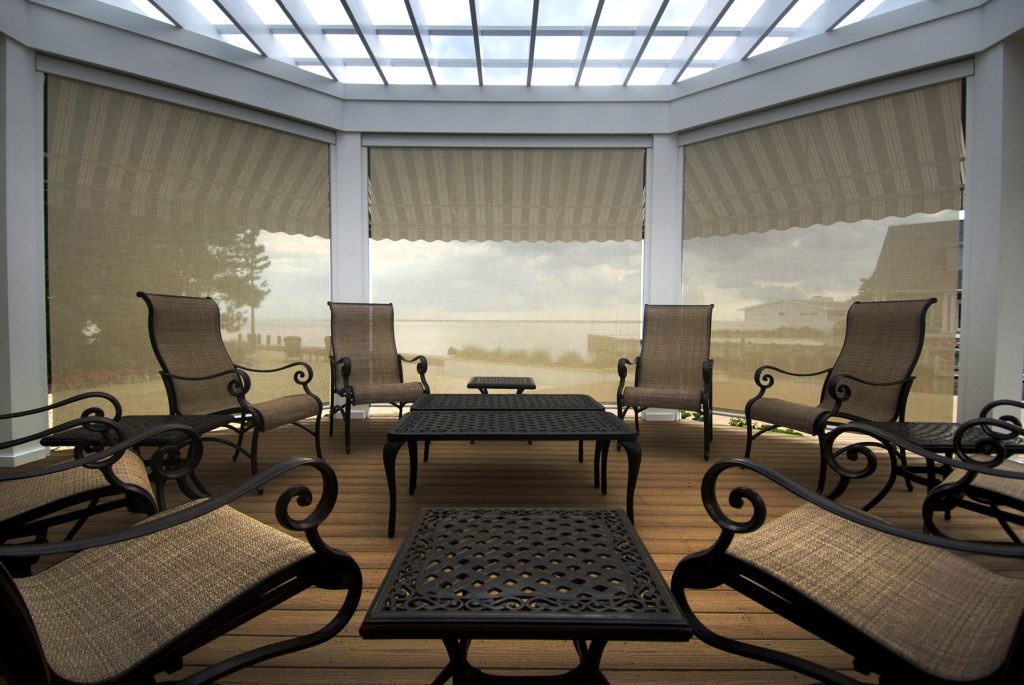
The Sentry is engineered for different mounting situations. It supports inside-mount, recessed-mount, surface-mount, and distance-mount configurations, which means it can go places The Sunroll can’t. Widths up to 18 feet; drops up to 12 feet. The flexibility in mounting makes it the right choice for homes where the standard cassette housing would conflict with the architecture — pergola columns, existing trim conditions, or unusual opening configurations.
Both systems are motorized. Both carry the same warranty structure as Sunesta’s awning line. And both are custom-built to your exact dimensions, which means neither is a close approximation of a fit — it either fits or it doesn’t, and Sunesta’s made-to-order approach means it always fits.
David Grant handles all Prestige Shade consultations and can walk you through which system is the right match for your specific space and how you plan to use it. There’s no pressure to decide before you’re ready.
The Outdoor Entertaining Case for August
Late summer is when you’re most likely to actually use a screen system. Here’s why.
Bug pressure peaks in August. Columbus mosquito populations reach their annual high point as the summer progresses, and evenings in late July through September are the worst window. If you’re hosting outside, bugs are not a minor inconvenience — they end parties early. A deployed screen system eliminates the problem at the perimeter. No bug spray required for guests.
West-facing glare is a real August issue. The sun angle in August creates aggressive late-afternoon glare on west- and southwest-facing patios, typically right during the hours (4–7 p.m.) when outdoor entertaining is most active. An overhead awning covers what comes down. A west-facing screen covers what comes in sideways. Together, they give you complete control over the light environment.
August evenings are worth extending. By 8 or 9 p.m. in August, Columbus temperatures are usually manageable — low 70s on a good night. Screens don’t change the temperature, but they eliminate the insects and improve the privacy enough that a gathering that might have moved indoors at dusk stays outside another hour or two. That’s meaningful if outdoor living is actually something you value.
The kids go back to school. Columbus-area school calendars typically start in mid-August, which means the back end of the month is when many homeowners finally reclaim their outdoor spaces for adult-oriented entertaining. That transition is a natural moment to think about what you wish your patio shade could do differently before next summer’s gatherings begin in earnest.
A Note on Smart Accessories for Outdoor Entertaining
If you’re adding screens for the entertaining use case, a few accessories significantly improve the experience:
Motorized operation with the MyLink2 app means you can control every screen and awning in your setup from a single interface on your phone. Deploy the west-facing screen without leaving the grill. Retract the awning when the sun drops without interrupting your conversation. Scheduled automation is also supported — you can set the screen to deploy each evening at a specific time so you don’t have to think about it.
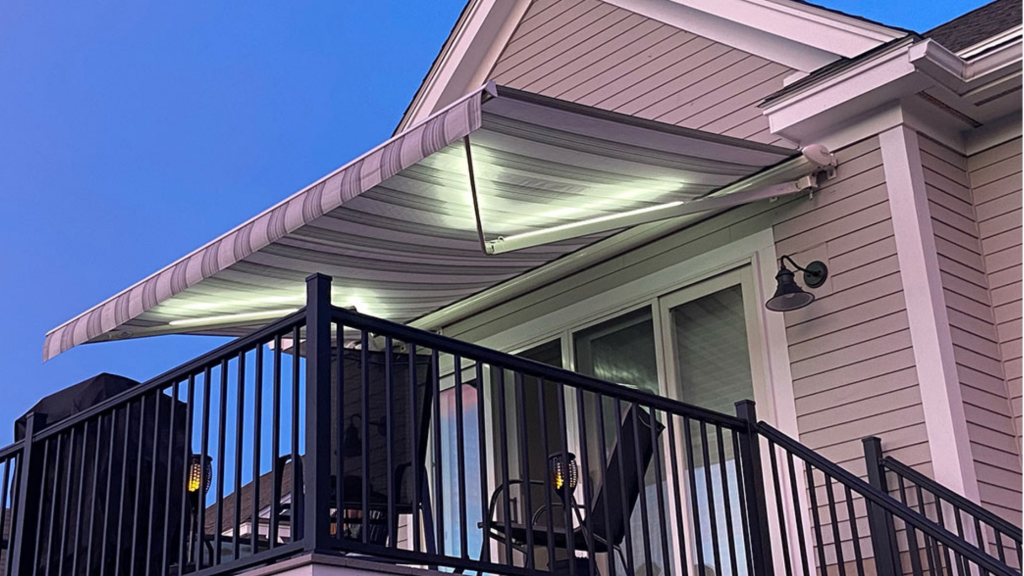
Smart Lights / LED lighting mounts directly to the awning frame and illuminates the space below with dimmable light. It’s plug-and-play — no electrician required — and it’s compatible with the MyLink2 app as well as standard remotes. For August evenings that stretch past sundown, this is the difference between heading inside and staying out.
Wind, sun, and rain sensors connect to the motor and retract the awning automatically when conditions warrant. Wind sensors are particularly useful for Columbus homeowners who leave their awning out during the day — if a storm moves through while you’re out, the sensor handles retraction before any damage can occur.
The Sunesta Quality Difference Applies to Screens Too
It’s worth mentioning, because screens are sometimes treated as secondary products: the same quality standards that apply to Sunesta’s awning line apply to their screen systems.
Every screen is custom-built in the United States to your exact specifications. The same Miami-Dade County NOA Product Approval that certifies Sunesta’s structural performance — earned through high-wind and severe-weather testing — reflects the engineering standards across the product line. The Skin Cancer Foundation Seal of Recommendation on Sunesta fabrics applies to screen fabrics as well as awning fabrics.
That matters for durability and for long-term value. A screen system that degrades in three seasons because it wasn’t built to withstand Ohio weather is not the same investment as a Sunesta screen that’s been manufactured to stand up to the same conditions the rest of the product line faces.
What the Process Looks Like
Prestige Shade’s process is the same whether you’re adding screens, an awning, or both.
It starts with a free in-home estimate. We come to your home, look at your patio, and talk through the options based on what you actually want to accomplish — not a scripted product pitch. He’ll tell you which system fits your space, what fabric and mounting options make sense, and what the finished installation will look like.
Because every Sunesta product is custom-made-to-order, installation is scheduled after your order is confirmed and production is complete. There are no stock items pulled from a warehouse. What arrives at your home is built for it. Professional installation is handled by Prestige Shade’s own team — no subcontractors — and includes full setup and a walkthrough so you understand exactly how to operate everything.
Financing is available through Acorn Finance and HFS Home Improvement Loans, subject to approved credit.
Make the Most of August
There are only a handful of weeks left where the evenings are warm enough to entertain outside without a second thought. If your patio has been losing hours to bugs, glare, or a lack of privacy, that’s solvable before the end of the summer.
Request a free in-home estimate with Prestige Shade to talk through what screens, an awning, or a combination of both could look like for your space.